· Updated · 8 min read · Omkar Satpute and Milind Soni
Meta Muse alternative: open source, runs on your machine
A Meta Muse alternative that is open source and keeps your data off Meta's servers, on the Claude, ChatGPT, or Grok account you already have.
MausBot is the open-source alternative to Meta Muse. Muse is one agent that lives in Meta's cloud, in the US, Canada, Japan, and Singapore, on Meta's models. MausBot runs one team of the AI agents you already have, such as Claude Code, Codex, and Grok, on your own machine, on the Claude, ChatGPT, or Grok account you already pay for. It is free and Apache 2.0 licensed.
What is Meta Muse?
Muse is Meta's personal AI agent, launched on September 8, 2026. You give it a goal and it does the work: it books, shops, reads your email and calendar, and asks you when a purchase needs a decision. It runs on Meta's own Muse Spark model, with Muse Wonder for paid subscribers since October 12, in a Linux virtual machine in Meta's cloud, with a browser it can drive.
- iOS, Android, web, and inside WhatsApp; a Mac app followed on September 17.
- United States, Canada, Japan, and Singapore, 18 and over; TechCrunch reported a payment card at signup at launch.
- Free tier with a usage meter; paid Power and Maximum tiers.
- One personal agent. You cannot create a second Muse with a different job.
- Keeps working after you close the app, and calls US businesses for paid subscribers since November 12.
CNBC reported on October 7 that it was still the top free iPhone app in the US. It also drew privacy questions from the start: The Verge's Emma Roth found it had worked out where she was visiting family from the shipping address on her Amazon order, and on September 20 Amazon blocked it from shopping on Amazon.com.
Why people look for a Muse alternative
These are the reasons we see most.
- It is Meta. Muse asks for your email, your calendar, your bank accounts through Plaid, and on the Mac your files and messages. For many people the question is not features but who holds the keys.
- It lives in Meta's cloud. Its VM in Meta's cloud is the system of record, even when the Mac app works in your files. Meta's own security post is honest that its current design does not prevent Meta from accessing VM data when necessary, and that a locked-down "Confidential VM" is planned, not shipped.
- It is in four countries. The US, Canada, Japan, and Singapore. Meta has announced no launch in the UK, the EU, or India.
- One agent, Meta's models only. You get Muse Spark, or Muse Wonder on a paid plan, and one Muse. If you already pay for Claude or ChatGPT, none of that is used, and you cannot give one agent your inbox and another your repos.
- Training is opt-out. Your conversations and tool calls, with key personal details removed, are used to train the model unless you turn it off.
What is MausBot?
MausBot keeps the promise, an agent that does the work while you do something else, and changes everything underneath. It runs one team of the AI agents you already have: every contact is a bot with its own model, computer, and connected apps, and a bot can be Chief of Staff and hand work to the others. Each bot runs on one of 16 agent engines, such as Claude Code, Codex, and Grok, on the account you already have, or on an API or local model. Your data stays in ~/.openmausbot on your own machine. The code is on GitHub under Apache 2.0, apart from an enterprise/ folder.
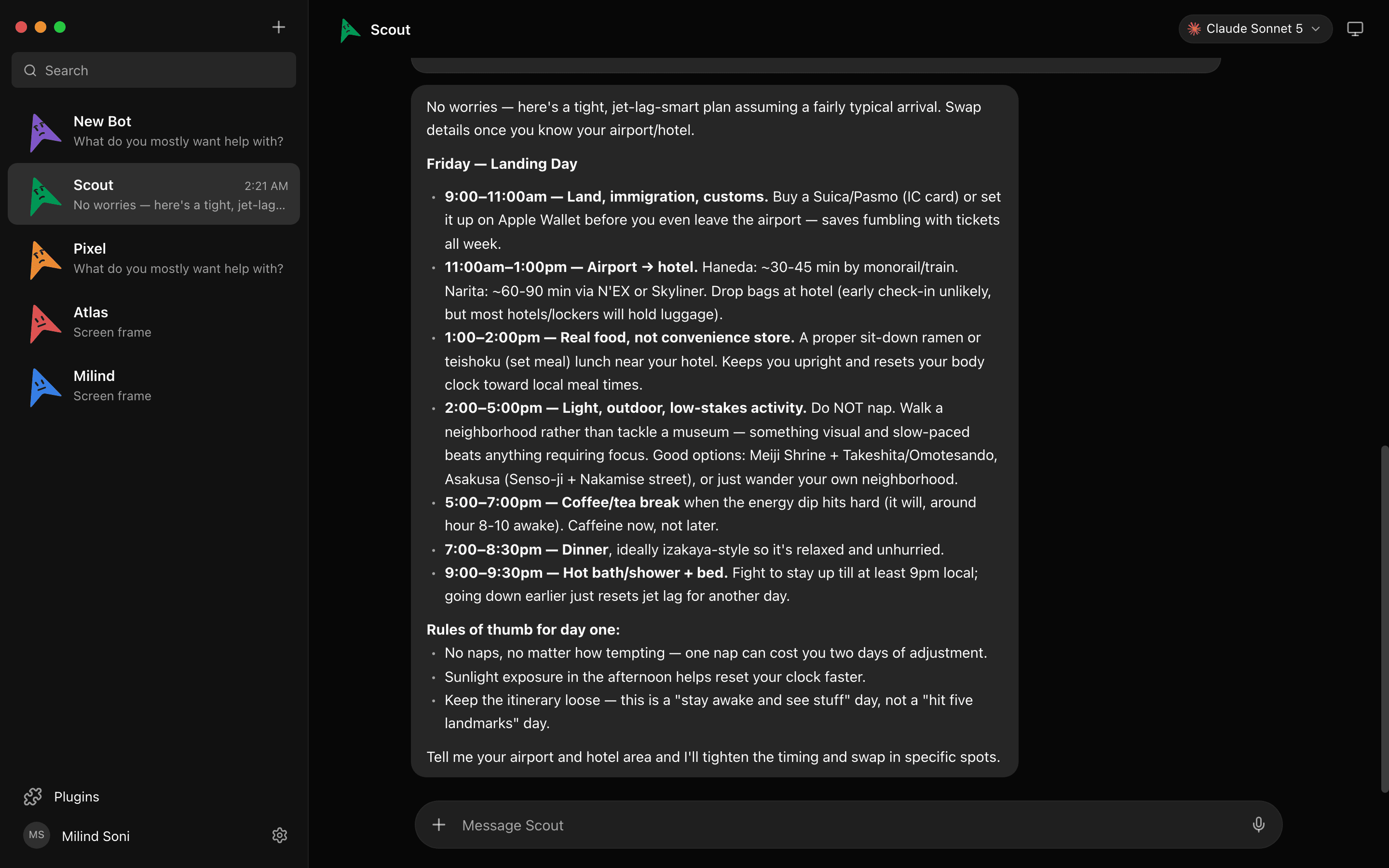
Try it. This is a live simulation of four bots working in parallel:
A simulation. Pick a bot, or type to it. The replies are scripted; the real thing runs on your own machine.
Meta Muse vs MausBot
Muse's side comes from Meta's own posts and the press coverage of its plans, as checked on November 15, 2026. Where Meta has not published a number, the cell says so.
| Meta Muse | MausBot | |
|---|---|---|
| Price | Free tier with a usage meter; Power $20 a month and Maximum $100. A card at signup at launch, per TechCrunch. | Free and open source. Bots run on the Claude, ChatGPT or Grok account, or the API key, you already have. |
| License | Proprietary. Meta released open weights for one model, Muse Spark Open, under its own license; the agent is closed. | Apache 2.0 on GitHub, apart from an enterprise/ folder |
| Where you can use it | US, Canada, Japan, Singapore; 18+ | No region limit of its own; your model provider's regions apply |
| Models | Meta's Muse Spark; Muse Wonder on paid plans | 16 agent engines (Claude Code, Codex, Grok, Cursor, Copilot and more), API and local models; chosen per bot, switchable mid-conversation |
| Where the agent runs | Muse Secure VM in Meta's cloud; the Mac app can drive apps on your Mac with permission | Your own computer or server; cloud computers with a live desktop on a Cloud plan |
| Where your data lives | Meta's servers; Meta's policy does not prevent it from accessing VM data when necessary | ~/.openmausbot on your own machine; prompts go only to the model provider you choose |
| Training on your sessions | On by default, opt-out | Kept in ~/.openmausbot on your machine; prompts go to your chosen provider under its own settings |
| How many agents | One personal agent | As many bots as you like, in group chats, with a Chief of Staff that hands out work |
| Approvals | Sentinel grants each permission; a purchase with a saved card asks you with the exact details every time | Full access by default, or Ask, Auto-accept edits or Approve for me per bot; sends can be set to ask every time |
| Connected apps | Email, calendar, Instagram, WhatsApp, Plaid, Link by Stripe, Walmart, Best Buy, and more | Gmail, Slack, Notion, LinkedIn and hundreds more apps, any MCP server, and bots' own numbers and inboxes |
| Scheduled routines | Yes, goals and background tasks | Yes: schedules, webhooks and app events |
| Keeps working with your laptop closed | Yes | Yes on a Cloud plan from $19 a month, or self-hosted free on your own server |
| Phone calls to businesses | Yes, US businesses, on paid plans | Yes, with a calling tool you connect: Vapi, AgentPhone or Telnyx |
| Platforms | iOS, Android, web, WhatsApp, Mac | macOS, Windows, Ubuntu; iPhone and Android apps |
| Self-host | No | Yes, free on your own server |
What MausBot does
Pick a model per bot
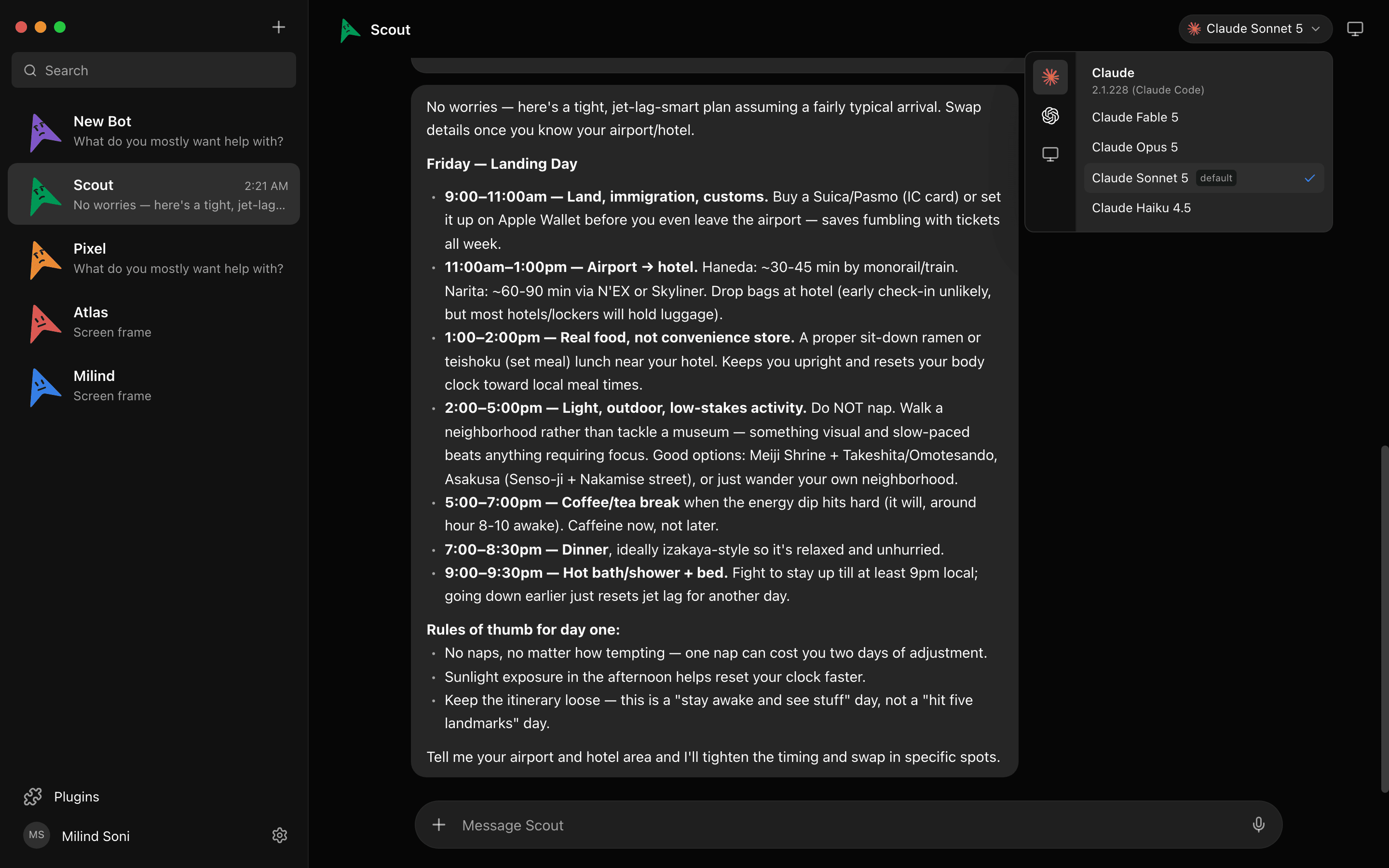
Muse is Meta's models. MausBot is whichever agent you already pay for. Claude Code, Codex, and Grok sit beside Cursor, GitHub Copilot, Kimi, OpenCode, Qwen, and the rest of 16 agent engines, plus API engines such as Mistral and OpenRouter and local models from Ollama or LM Studio. Give one bot Claude for writing and another Codex for code, and switch mid-conversation.
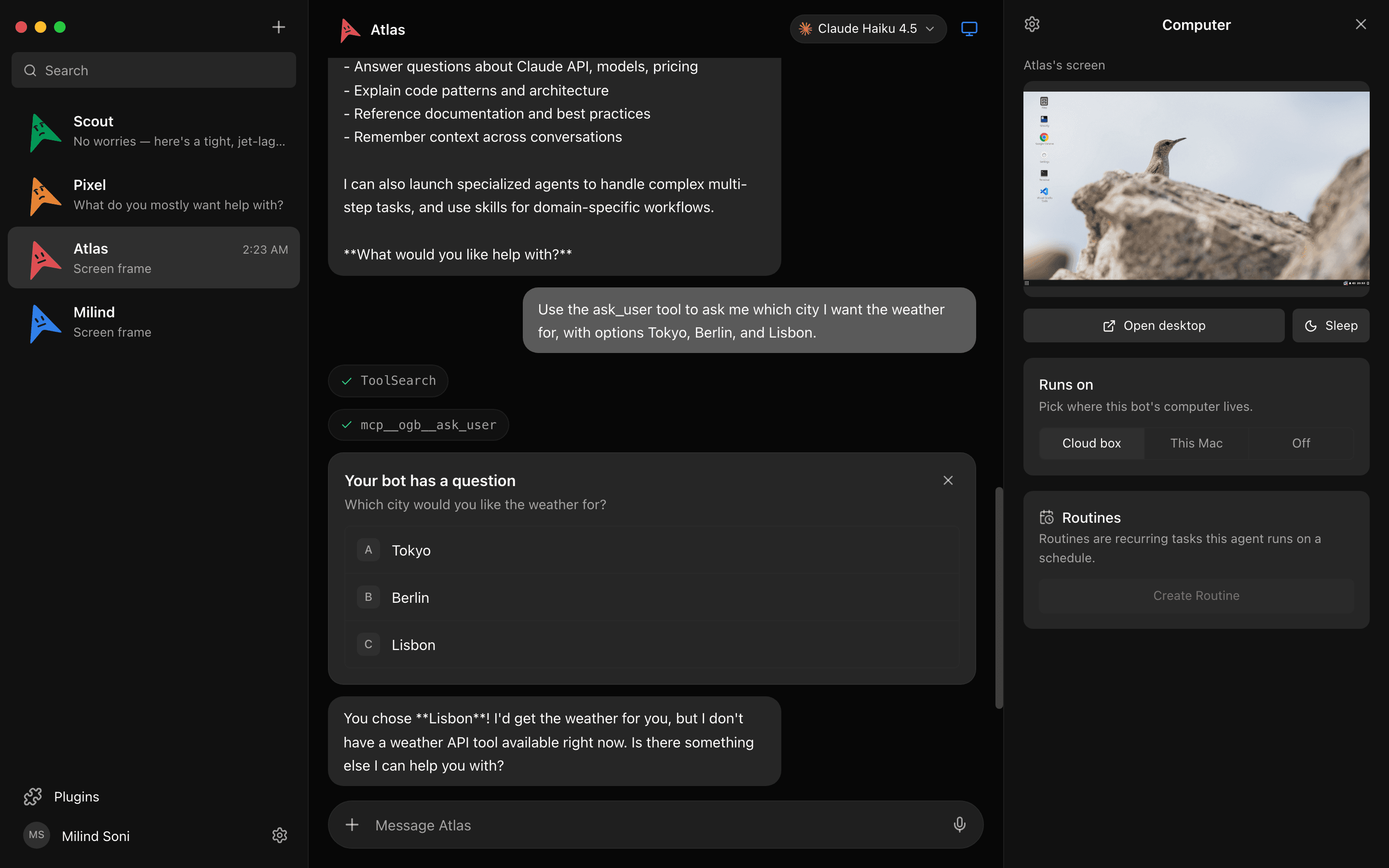
A computer per bot, yours or a cloud one
Muse gives you one VM in Meta's cloud. In MausBot a bot can work on your own machine or in your own Chrome, and on a Cloud plan it gets a cloud computer with a live desktop you can watch or take over.
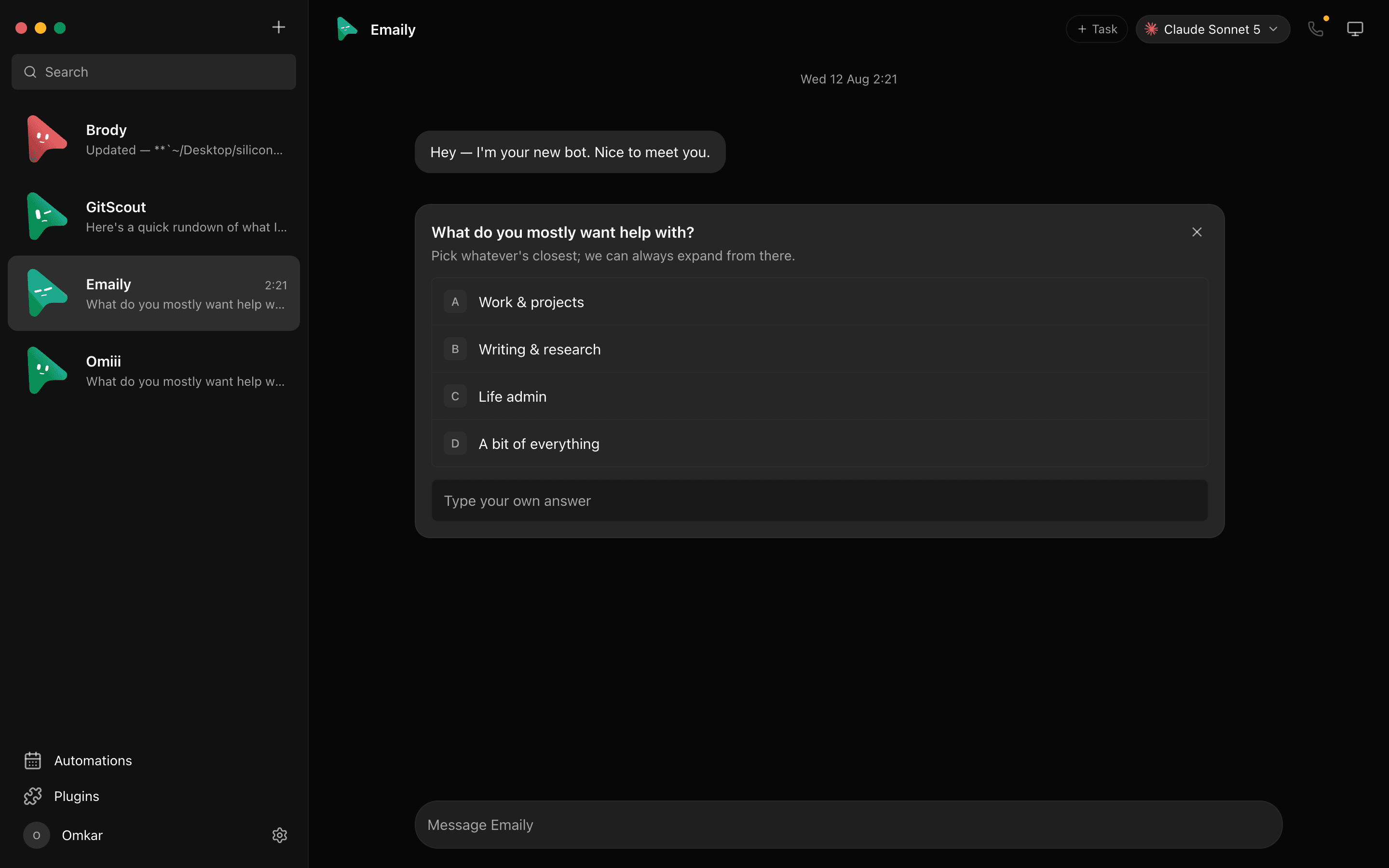
You set how much a bot asks
This changed in October. Every new bot now starts at Full access: the engine runs in its most permissive mode, and only real questions and missing sign-ins reach you, as cards in the chat. Muse gates purchases; in MausBot you choose per bot or thread between Full access, Ask for approval, Auto-accept edits, and Approve for me, and you can set sends through connected apps (email, messages, posts, and payments) to ask every time.
Connected apps
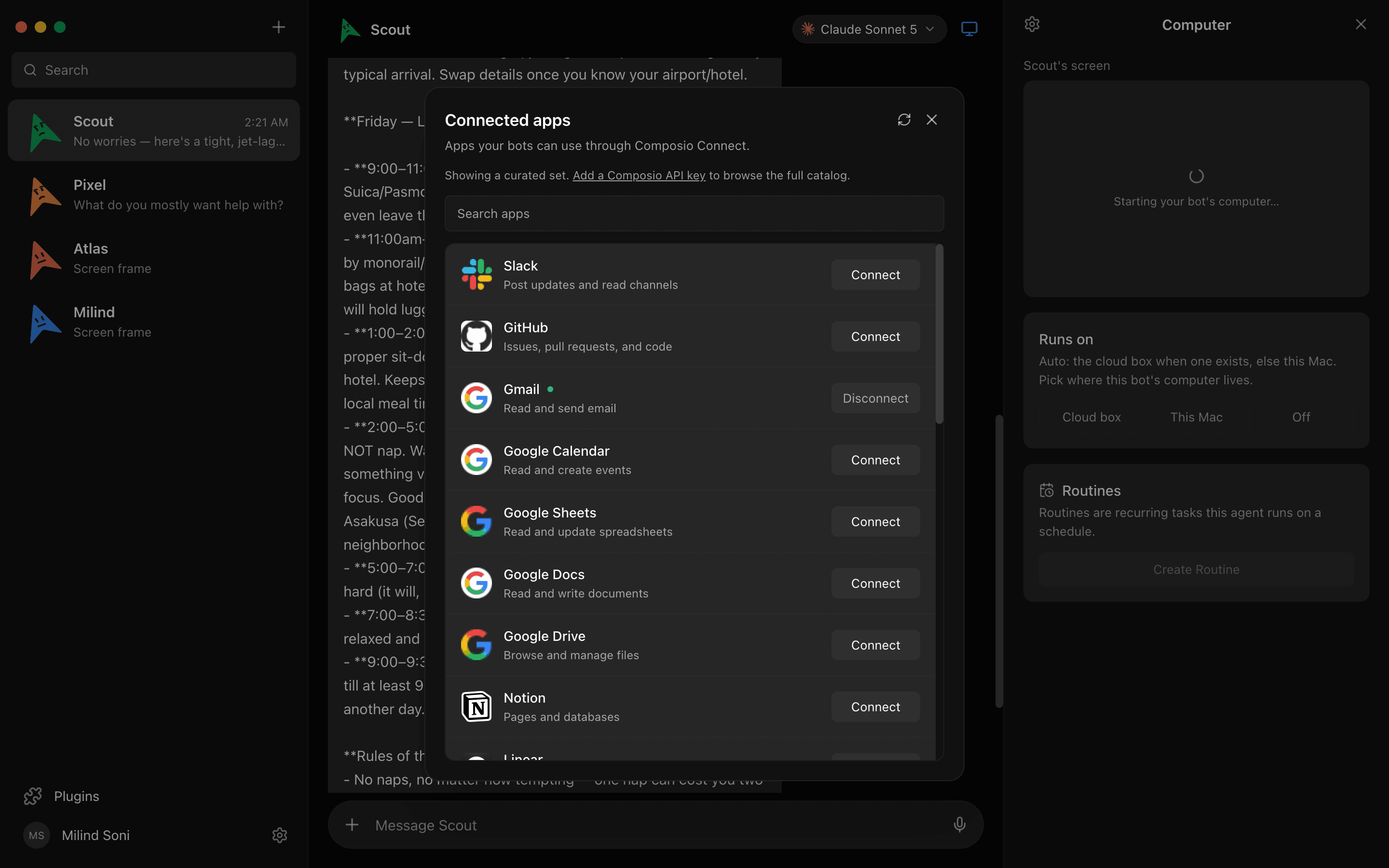
Gmail, GitHub, Notion, Slack, Outlook, LinkedIn, Calendly, and hundreds more through a managed Composio service; sign in once. Add any MCP server, even from chat, and give bots their own inboxes through AgentMail and their own phone numbers through AgentPhone or Telnyx.
A team, not a single Muse
Muse is one agent. MausBot starts with a team. Put bots in a group chat, make one the Chief of Staff, and it hands work to its teammates. On a Team plan, people share their bots and a team memory, and every bot reads the About me notes you keep about yourself.
Bots that talk back
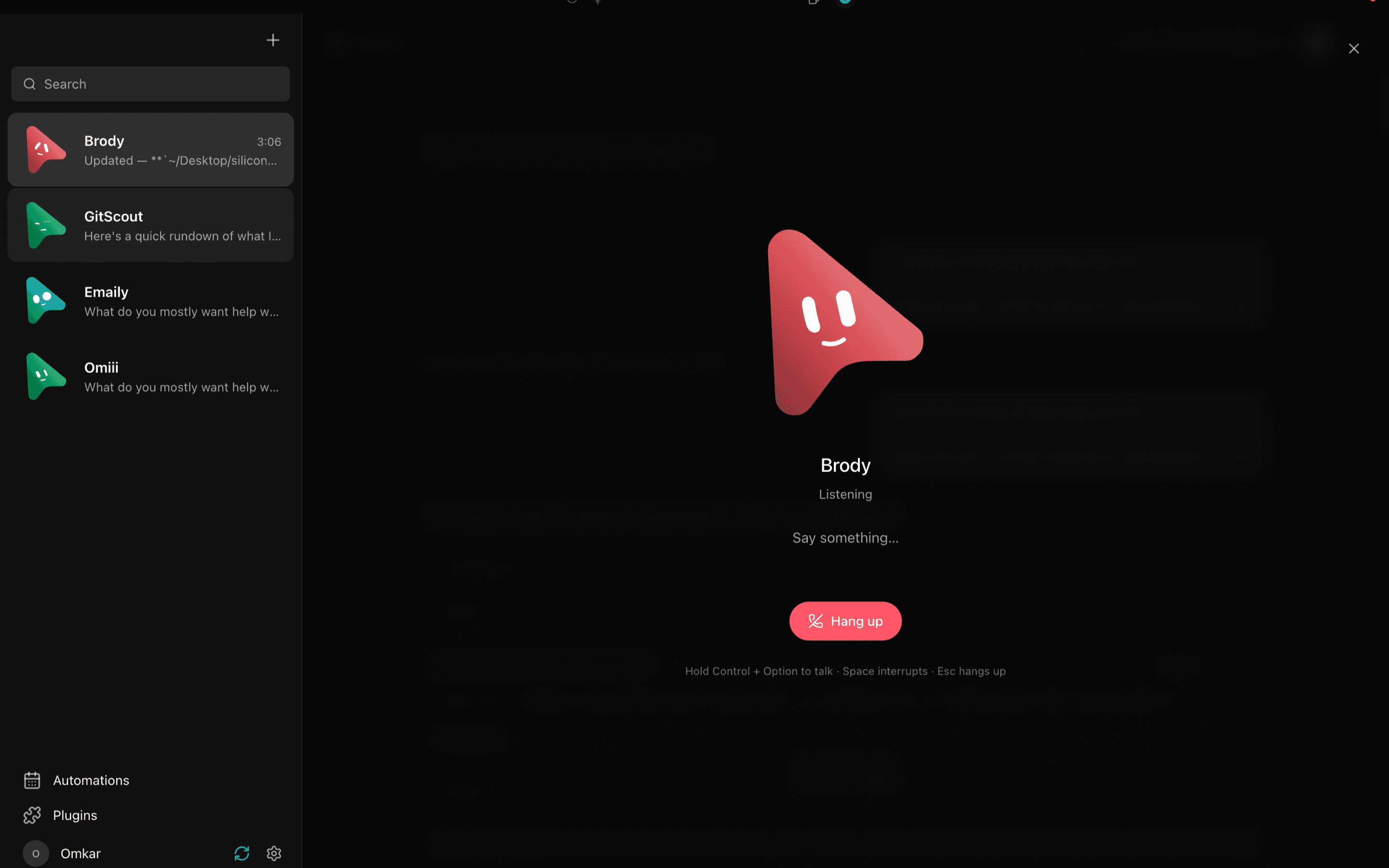
Hit call and have a conversation with a bot, on your own OpenAI key. The bot hears you and answers out loud. Cloud plans add voice replies.
What Muse still does better
A few things, and they are real. Muse keeps working after you close the app on every task, with nothing for you to run; MausBot does that on a Cloud plan from $19 a month or on your own server. Muse includes calls to US businesses on its paid plans, where MausBot needs a phone tool you connect. It answers in WhatsApp, connects your bank accounts through Plaid, and pays with single-use card numbers. And Meta has published open weights for its Muse Spark Open model. If those are the jobs, Muse is the better tool today.
Other Meta Muse alternatives
MausBot is not the only option, and the right one depends on what you want to own.
- OpenClaw is the most-starred self-hosted agent, reached over messaging apps and now native desktop and phone apps. Powerful, with a rough security record this year and no hosted option.
- Hermes Agent from Nous is a self-hosted agent with a desktop app and an official Hermes Cloud option, closer to a single assistant than a team.
- Grok Bot from xAI is the closest product to MausBot in shape, a roster of bots in a messaging app, but it picks the model for you, runs cloud first, and needs The X Subscription's Premium plan ($30 a month) or higher, or a linked SuperGrok, X Premium+, or paid Cursor plan. We compared them line by line in Grok Bot vs MausBot.
- Claude Cowork from Anthropic works on your files, apps, and browser on paid Claude plans: Claude only, one Claude that coordinates sub-agents, on desktop for macOS, Windows, and Linux (beta), web, and mobile.
Which one should you choose?
Choose Meta Muse if you are in the US, Canada, Japan, or Singapore, you want one assistant with no model account to set up, you need it to keep going with your phone in your pocket, and you are comfortable with Meta holding the accounts it works in.
Choose MausBot if you are somewhere else, you already pay for Claude, ChatGPT, or Grok, you want more than one agent with more than one job, you need your data on your own machine, or you have a security review to pass.
For Muse against the other new agents, see Meta Muse vs OpenAI dots and the five-way Muse vs Grok Bot vs Dots vs Cue; for a decision in five questions, Which AI agent should I use?.
Open Muse: what people mean by it
Searches for "open muse," "openmuse bot," and "open muse github" all ask the same question: is there an open-source Muse? There is no open Muse from Meta. The agent is closed, and the only thing Meta has opened is a model's weights, Muse Spark Open, under its own license, which does not make the agent self-hostable. Several GitHub projects have used the name, including CopilotKit's OpenMuse, renamed OpenFuse in November, and nanoMuse, which began as OpenMuse; we compare them on our OpenMuse page. What most people want when they type it is an agent shaped like Muse whose code they can read and whose data they keep. That is what MausBot is: one team of agents with their own computers, under Apache 2.0, on the models you already pay for.
Frequently asked questions
- Is Meta Muse open source?
- No. The Muse app, the agent harness, and its cloud VM are proprietary. In October 2026 Meta released open weights for one model, Muse Spark Open, under its own Muse Model License, but the Muse agent still runs only in Meta's cloud. MausBot is Apache 2.0 on GitHub, apart from an enterprise/ folder.
- Is Meta Muse available in India, the UK, or the EU?
- Not as of November 15, 2026. Meta has launched Muse in the United States, Canada, Japan, and Singapore, for people 18 and over; no other country has a date. MausBot has no region limit of its own: it runs wherever your own model account or API key works.
- Is Meta Muse free?
- There is a free tier with a usage meter. Power is $20 a month and Maximum $100, and TechCrunch reported at launch that a payment card was required to start. Calls to businesses and the Muse Wonder model need a paid plan. MausBot has no quota of its own; you keep paying your model providers exactly what you pay them now, and Cloud plans from $19 a month are optional.
- Does MausBot need Meta or any Meta account?
- No. MausBot is made by Supamaus and has no tie to Meta. Bots run on the Claude, ChatGPT, or Grok account, or the API key, you already have.
- Can MausBot make phone calls like Muse?
- Yes, once you connect a phone tool: one-click cards for Vapi, AgentPhone (US and Canadian numbers), and Telnyx (numbers in many countries) let bots place calls. You can also have a live voice call with a bot on your own OpenAI key. Muse includes calls to US businesses on its paid plans.
- Where does my data go?
- Data is stored in
~/.openmausboton your own machine, or on your own cloud machine if you take a Cloud plan. Prompts go to the model provider each bot uses, under that provider's own settings. - Is there an open-source Muse, or an "open muse"?
- Not from Meta. Muse is closed, and the only thing Meta has opened is a model's weights, Muse Spark Open, under its own license. Several GitHub projects took the OpenMuse name after launch; we compare them on our OpenMuse page. The closest open-source Muse in shape is MausBot: the same personal-agent idea, with several agents instead of one, running on your own machine under Apache 2.0.
Get started
Download for macOS, Windows, or Ubuntu, let MausBot install Claude Code or Codex for you or bring the account or API key you already have, and meet your first bot. The app has no region limit of its own. Or read the source on GitHub first. The app is free, and the features list shows what it does.
This post is based on the products as they were on . Products change. If something here is out of date, tell us and we will correct it.